In my free time, I enjoy watching movies and knitting. I am also passionate about issues related to community and labor justice, and as a graduate student I contributed significantly to building Georgia State Universtity's campus workers union.
I'm happy to talk about research and anything else I mention on my website. Feel free to shoot me an email at jfalcone2 [at] sc.edu !
About Me
My Research
Some of the techniques I use in my research involve the reduction and analysis of the Kitt Peak Ohio State Multi-Object Spectrograph (KOSMOS) at Apache Point Observatory (APO), where I currently have over 150 hours of observing experience. I have significant experience with spectral fitting analysis, and have been contributing to a Gaussian fitting routine called BEAT since 2023. I currently help maintain the documentation.
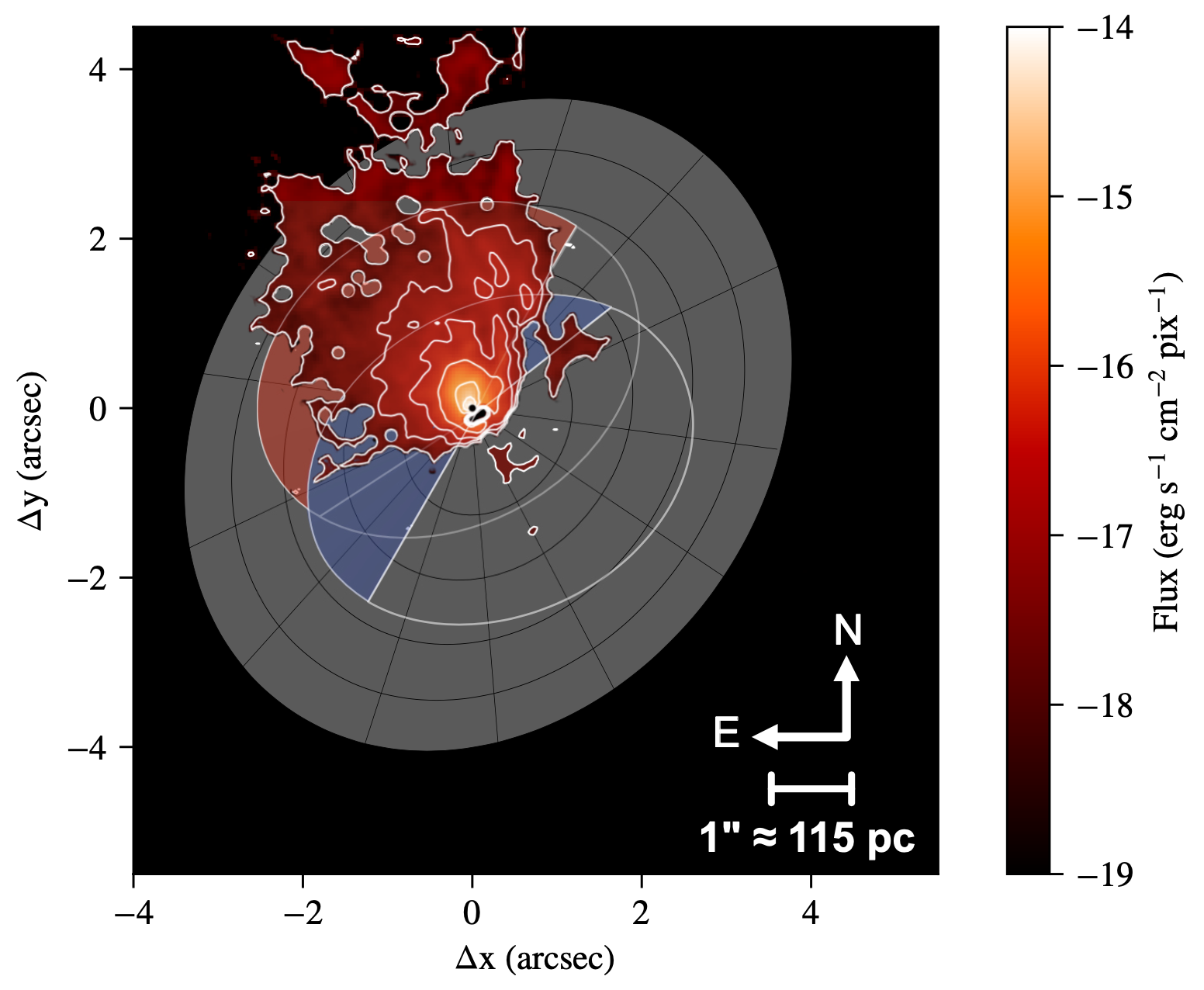
My second study is an expansion of the first, still focusing on the outflows in NGC 3227. In this work, we quantify spatially-resolved mass outflow rates in three gas phases (cold molecular, warm molecular, and ionized) and apply it to the molecular gas reservoirs around the SMBH to estimate the evacuation timescales of the reservoirs. This study was published in January 2026 and you can read it here.
I defended my PhD at Georgia State University in April 2026. You can see a recording of the talk here. If you don't have 50 minutes to spare (and in this economy, who does?), you can watch an abbreviated version of my defense here.
Outreach & Teaching
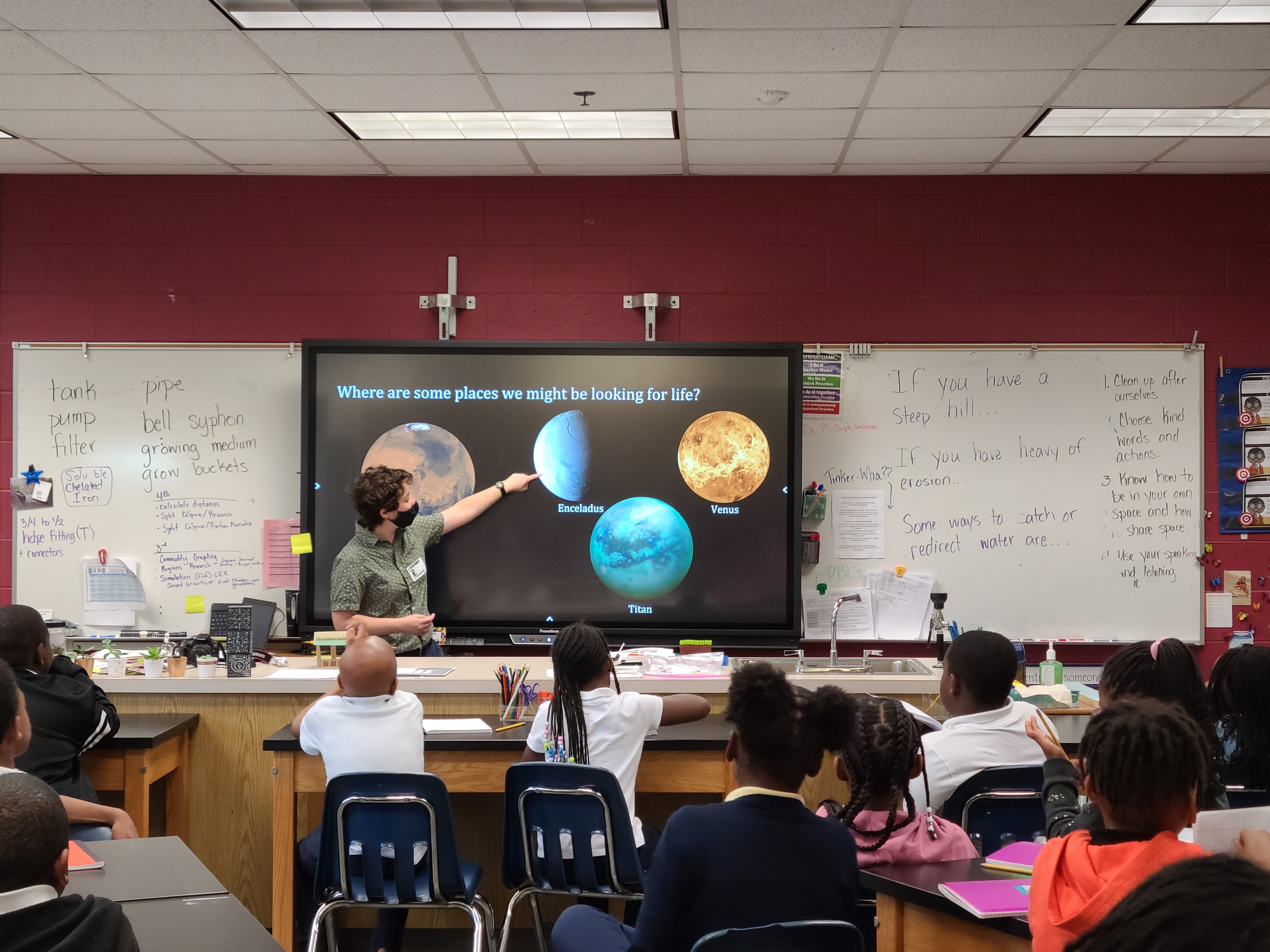 From 2021 - 2025, I was a Graduate Lead in the Georgia Outreach Team for Space (or GOT Space), an outreach program affiliated with Georgia State University, the Georgia Space Grant Consortium, the National Science Foundation, Georgia Institute of Technology, and a few other universities. As a lead organizer, some of my responsibilities include coordinating outreach events with educators, partaking in outreach events (which you can see in the image on the left!), and overseeing the content to be presented at outreach events. In 2024, GOT Space launched Astro on Tap Atlanta, which is a satellite of the broader Astro on Tap initiative. These monthly events bring in 50-100 adults from around the metro Atlanta to a local tavern to hear about astronomy, and has become the tavern's most popular recurring event.
GOT Space was awarded a $30,000 grant to host AsTropaLooza: An Astronomy of ATL Showcase, which was a 4-day event that occurred in June 2025. As a Co-I of this proposal, my primary responsibilities involved coordinating the various parties of volunteers and participating institutions, communicating with interested Atlanta-area educators, designing our publicity materials, and facilitating the activities themselves. We engaged hundreds of K-12 children over these events, and intentionally worked to make AsTropaLooza accessible to underserved communities by providing $100 rideshare vouchers upon request to several families.
I also have a passion for teaching, which I was able to nurture during my time at GSU. I TA'd a total of 15 introductory astronomy lab classes, over which time I was able to grow my skills as an educator, especially towards non-majors. Oftentimes, the quest for good grades can put students at odds with their physical or mental health, or with other obligations such as family care or work. I've spent a lot of time crafting policies for my lab classes that don't require students to make sacrifices, meaning they can prioritize their immediate needs and still succeed in the lab class.
For the Fall 2025 semester, I was the instructor of record for one class of ASTR 1010: Astronomy of the Solar System, an introductory class for non-majors. I chose to pursue this opportunity to further strengthen my pedagogical and organizational skills within an academic context, and as I move forward throughout my career, I intend to continue to learn and grow as an educator with an emphasis on accessibility for all.